

Etcetera Language Group provides desktop publishing services for brochures, manuals, catalogs, packaging, and technical documents that need to look polished and production-ready in every language they are translated into. Translation alone only solves half the problem. If the finished file looks crowded, broken, or inconsistent once the translated text is dropped into the layout, the professional impression suffers along with it.
Our multilingual desktop publishing team combines layout expertise with translation workflow coordination, so files arrive ready for print or digital distribution instead of needing manual cleanup after the fact. That coordination matters because translated text rarely fits the same way the source version did, and catching the mismatch early is far cheaper than fixing it after a print run.
What Are Desktop Publishing Services?
Desktop publishing services, often shortened to DTP, cover formatting, layout, typesetting, and final file preparation for translated or multilingual content. The goal is to preserve readability, visual consistency, and a professional presentation once translated text is placed into a design.
Some languages expand when translated, some contract, and others require different punctuation, spacing, or reading direction entirely. Our multilingual DTP process adapts the layout so the final file still looks intentional rather than patched together after the fact.
What Our Desktop Publishing Work Covers
- Typesetting and layout adjustment: spacing, line breaks, pagination, and alignment after translation
- Font and character support: proper rendering for accented characters, symbols, and non-Latin scripts
- Graphics and callout updates: repositioning labels, captions, and diagrams to fit translated text
- Template consistency: maintaining branding and visual hierarchy across every language version
- Print-ready and digital-ready output: files prepared for production, distribution, or internal use
- Quality review: a final pass to confirm nothing shifted, truncated, or misaligned during layout
Why Layout Quality Matters in Multilingual Communication
When a company expands into international markets or serves multilingual audiences, formatting becomes part of the message. A clean, well-adapted layout improves readability, supports comprehension, and helps content look credible to customers, partners, employees, and regulators alike.
Common Problems Our Desktop Publishing Services Solve
- Text expansion that breaks tables, headings, or callout boxes
- Font incompatibility with accented characters or non-Latin scripts
- Misaligned graphics, labels, or captions after translation
- Inconsistent branding across different language versions
- Manual file cleanup that slows production and adds cost
Designing for Scripts Beyond Latin Text
Expansion and contraction are only part of the layout challenge. Arabic and Hebrew read right to left, which flips the entire visual flow of a document, including where icons, navigation elements, and image callouts belong relative to the text. Chinese, Japanese, and Korean characters carry more visual weight per character than Latin letters do, so a line that looks balanced in English can feel cramped once it is set in those scripts, even when the character count actually goes down. Thai, Hindi, and several other scripts need noticeably more vertical space between lines than English does, since their characters are taller and more complex. A layout built only with English in mind rarely survives contact with any of these scripts without adjustment, which is exactly the kind of adjustment our desktop publishing team plans for before a single word gets placed.
The Layout Challenge Behind Multilingual Documents
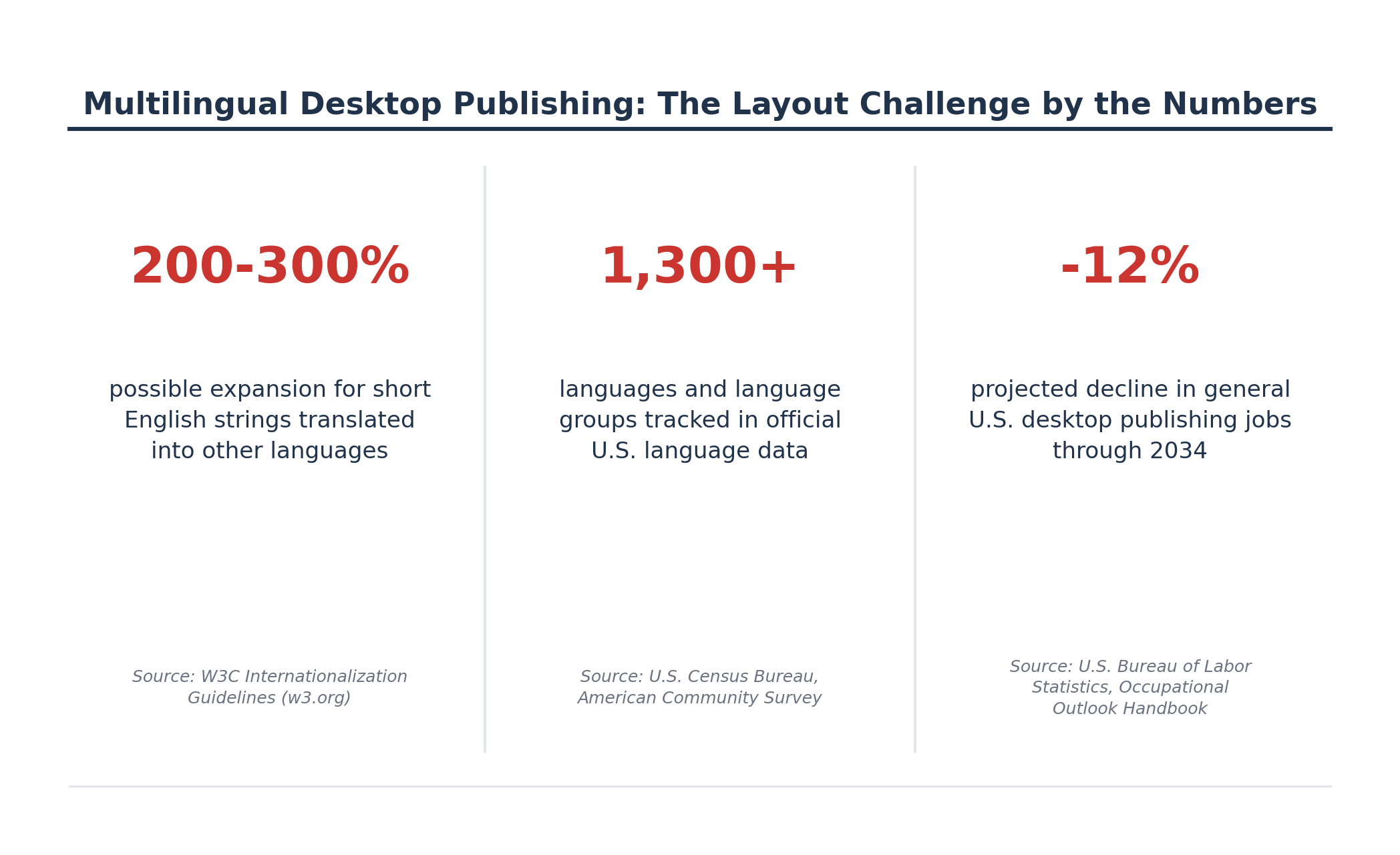
Text length is one of the biggest hidden risks in multilingual layout. According to the W3C’s internationalization guidelines, short English strings can expand by 200 to 300 percent once translated, which is exactly the kind of change that breaks a button, table cell, or caption sized only for the original English. The scale of that challenge multiplies quickly given how many languages exist to design for. The U.S. Census Bureau’s most recent detailed language tabulation classifies responses into more than 1,300 possible languages and language groups. At the same time, the U.S. Bureau of Labor Statistics projects general desktop publishing employment to decline 12 percent by 2034, even as demand for specialized, translation-aware layout work continues. That combination is a big part of why multilingual DTP tends to be outsourced to a team that handles it regularly rather than handled in-house as an afterthought.

Our Desktop Publishing Process
Our workflow is designed to keep multilingual content clean, consistent, and production-ready without creating unnecessary back-and-forth for your team, from initial file review through final delivery.
- File review and production planning: we review source files, target languages, intended output, and formatting requirements to determine how translated content should be placed and adjusted.
- Text placement and layout adaptation: translated content is inserted into the working files or templates, and the layout is adjusted for language-specific expansion, contraction, and reading flow.
- Font, graphics, and visual quality check: we check font support, spacing, visual balance, alignment, image callouts, captions, and other visual elements so the document remains readable and professionally presented.
- Final output for print or digital use: once formatting is complete, we deliver files in the required output format so materials are ready for print vendors, digital distribution, or internal deployment.
We support multilingual formatting across common design environments used for brochures, manuals, packaging, catalogs, and technical documentation, including Adobe InDesign, Adobe Illustrator, Adobe Photoshop, QuarkXPress, Microsoft Publisher, and common office and PDF output formats. If your files include embedded graphics or styled templates, we can review the format and recommend the most efficient workflow before production begins. Working directly from your original design files, rather than a flattened export, also tends to save time and cost later, since editable text frames and layered graphics are far easier to adjust for a new language than a static image would be.
Types of Materials We Format
Our desktop publishing services support both internal and customer-facing materials across a wide range of industries, on projects where presentation quality matters just as much as translation accuracy.
- Brochures and flyers
- Product catalogs
- Technical manuals
- User guides and instruction sheets
- Training materials and presentations
- Packaging content
- Compliance and safety materials
- Multilingual marketing assets
Industries That Rely on Multilingual Desktop Publishing
Any organization producing multilingual materials can benefit from professional DTP support, but it tends to matter most where formatting precision, technical clarity, or regulated content is involved, and where a layout mistake would be costly, embarrassing, or both to catch after printing.
Manufacturing and Heavy Machinery
Assembly instructions, safety warnings, and compliance-sensitive documentation all need consistent layouts across every language revision, particularly when a mistranslated measurement or misplaced warning label carries real safety consequences.
Medicine and Pharmaceuticals
Patient-facing documents and regulated materials depend on formatting that stays clear and consistent across every translated version. For general best practices around labeling, see the FDA’s labeling guidance.
Consumer Goods and Marketing
User manuals, packaging, and campaign collateral all need to stay on-brand after translation, with layout adjustments for text expansion and contraction built in so materials are ready for distribution without a second round of fixes.
Our team also frequently pairs desktop publishing with document translation services so a project moves from source content to finished, formatted deliverable in one coordinated workflow, and with human translation services when tone and context need the same level of attention as layout.
Why Choose Etcetera Language Group for Desktop Publishing
- Family-owned and operated since 1996
- Support for numerous languages and scripts
- Experience with layout-sensitive materials across industries
- Compatible with a wide range of file formats and design workflows
- Available to clients across the United States and Europe
- Consistent formatting review before every delivery
Layout-sensitive projects often benefit from an additional review layer. Our translation proofreading and editing service can run alongside DTP work, and clients working with contracts or regulated filings sometimes pair layout support with our legal translation services for a fully coordinated deliverable. For a broader view of what we offer beyond layout and formatting, our professional language translation services overview covers the complete lineup.
FAQs About Desktop Publishing Services
What are desktop publishing services?
Desktop publishing services include layout, formatting, typesetting, and final file preparation for print-ready or digital-ready materials, especially after translation.
Why do translated documents need desktop publishing?
Translated text often changes in length, spacing, and structure. DTP helps ensure fonts, tables, line breaks, graphics, and layouts still look polished and readable in the target language.
Can you work with InDesign, Illustrator, and similar design files?
Yes. We commonly support professional design environments and can review your files to confirm the best production workflow for multilingual formatting.
Do you provide translation and desktop publishing together?
Yes. We can coordinate translation with multilingual DTP so your project moves from source content to final formatted deliverable in one process.
What file types do you support?
We support many common office, PDF, and design-related file formats. Send the file type or a sample file and we can confirm compatibility.
What kinds of materials benefit most from DTP?
Brochures, manuals, catalogs, training materials, packaging, technical documentation, and multilingual marketing collateral are all common use cases for professional desktop publishing.
Request a Free Quote
If your team needs multilingual formatting support for brochures, manuals, catalogs, technical documents, or regulated content, Etcetera Language Group is ready to help. Contact our team to discuss your project and request a quote.