

Translation proofreading and editing help make sure translated content is accurate, natural, and ready for professional use. Even a strong first translation can carry subtle problems with tone, terminology, flow, or formatting, and those small issues have a habit of turning into credibility problems right when a document matters most.
Etcetera Language Group provides translation proofreading and editing for businesses, legal teams, healthcare organizations, academic clients, and other groups that need polished multilingual content. Whether the project is a newly translated document, high-visibility marketing material, or a machine-generated draft that needs a human pass, our review process protects meaning while improving readability across every stage of the workflow.

Why Translation Proofreading and Editing Matter
Direct translation alone does not always produce a strong final document. A sentence can be technically correct and still sound unnatural, miss the intended tone, soften a critical detail, or use inconsistent terminology throughout a longer file. Proofreading and editing close that gap before the document reaches its audience.
- Improves readability: translated text flows more naturally for native readers
- Protects meaning: the original intent, context, and message stay intact
- Eliminates errors: grammar, punctuation, spelling, and formatting issues get corrected
- Enhances consistency: terminology and phrasing stay aligned throughout
- Strengthens credibility: the final content looks polished and publication-ready
- Supports acceptance: official reviewers and native readers notice fewer rough edges
This is particularly important for content used in legal, medical, technical, academic, and customer-facing environments, where wording quality directly affects understanding and trust.
Translation Editing and Translation Proofreading Are Not the Same Step
Editing and proofreading are closely related, but they do different jobs. Many projects benefit from both, since one improves the message itself while the other cleans up the final presentation before delivery. Understanding which one a document needs, or whether it needs both, is often the difference between a quick turnaround and a project that has to circle back for a second round of fixes.
| Service | Primary Focus | Typical Timing |
|---|---|---|
| Translation Editing | Structure, tone, terminology, clarity, and meaning | Right after the initial translation draft |
| Translation Proofreading | Grammar, spelling, punctuation, formatting, and final presentation | At the final review stage before delivery |
Editing strengthens the content itself. Proofreading confirms the final version is clean, consistent, and ready to use. Industry groups such as the American Translators Association point to multi-step review as a core part of professional translation quality.
How Our Translation Proofreading and Editing Process Works
Every project starts with a quick assessment of what the document actually needs. A newly translated contract heading into legal review calls for a different depth of editing than a marketing brochure that just needs a final proofread before it goes to print. From there, the right reviewer, someone with relevant subject-matter background and native fluency in the target language, works through the file methodically rather than skimming for obvious typos.
What We Review During Editing
- Sentence structure and grammar
- Terminology and word choice
- Tone, voice, and audience fit
- Missing, softened, or distorted meaning
- Flow, coherence, and readability
What We Review During Proofreading
- Spelling, grammar, and punctuation errors
- Formatting consistency and layout issues
- Headings, labels, and table presentation
- Final comparison against the source
- Readability for native-language end users
Editing is ideal for documents that will be published, submitted, or reviewed closely by native-speaking readers, and it is especially useful for revising content created through human translation services or for cleaning up a rough draft produced by software. Proofreading matters most for certified translations, legal filings, medical documents, and formal submissions where presentation quality affects acceptance.
The Case for a Second Set of Eyes
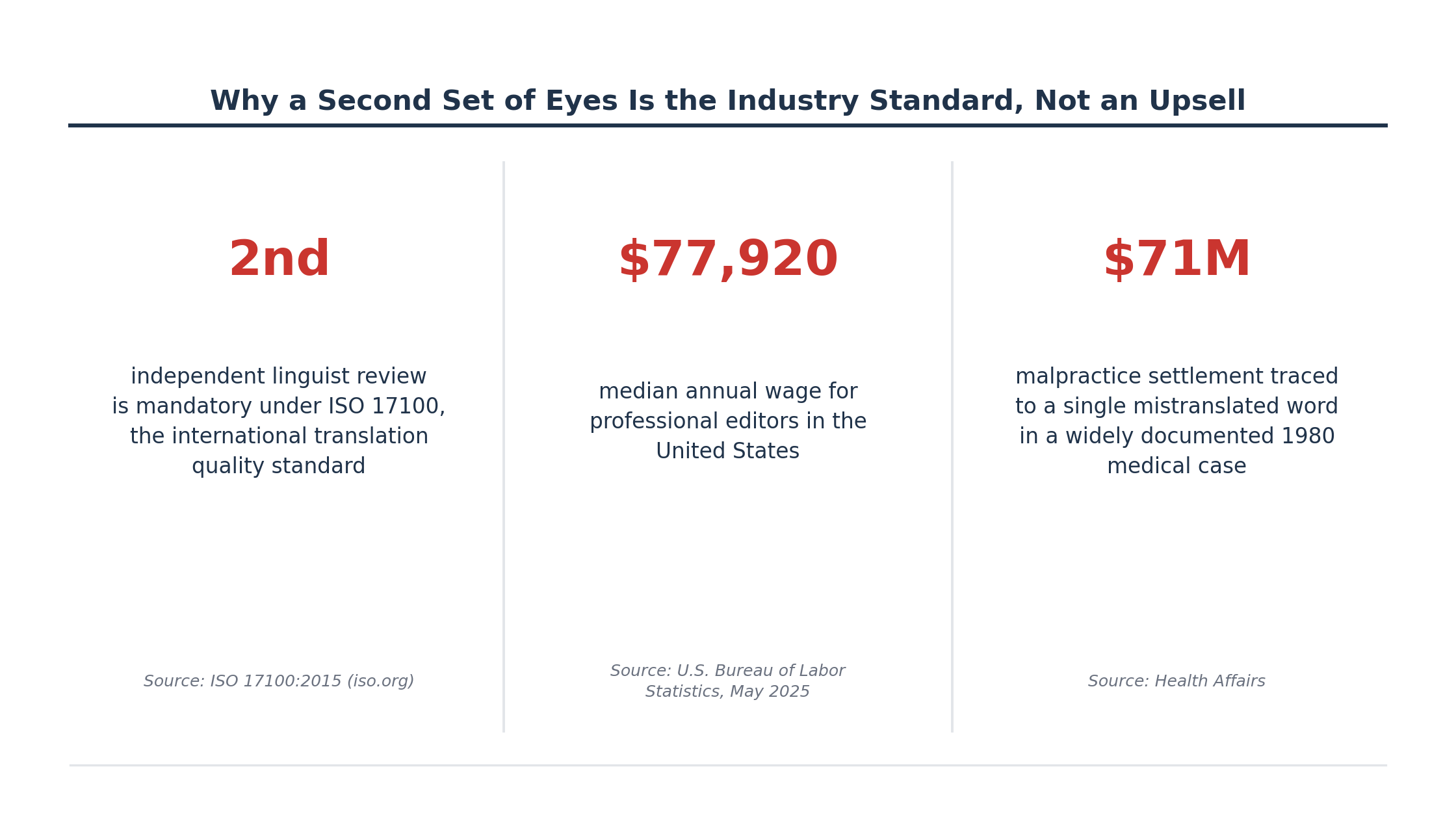
Independent review is not a marketing claim, it is a documented industry requirement. ISO 17100, the international standard for professional translation services, requires that every translation be revised by a qualified linguist other than the original translator before it can be considered conformant. That step exists because a single translator rarely catches every issue in their own work. The value of a second reviewer also shows up in the numbers around the profession: the U.S. Bureau of Labor Statistics reports a median annual wage of $77,920 for professional editors, reflecting how much skill goes into this kind of review. The stakes of skipping it can be severe. One of the most widely documented examples, detailed in the health policy journal Health Affairs, traces a $71 million malpractice settlement back to a single misunderstood word in a 1980 medical case, a reminder that unreviewed language can carry consequences well beyond an awkward sentence.
When This Extra Layer of Review Is Most Useful
Not every document needs the same review depth, but proofreading and editing tend to matter most in situations where precision, tone, and final polish carry real weight.
- Client-facing documents and marketing materials
- Official submissions and certified translations
- Legal, medical, and technical documentation
- Multilingual websites, product pages, and brochures
- Machine-translated drafts that need human cleanup
- High-visibility presentations, reports, and training materials
If a file also needs layout cleanup or multilingual formatting support, our desktop publishing services can help preserve structure and presentation alongside the language review.
Industries That Rely on This Kind of Language Review
Organizations across industries use proofreading and editing to reduce risk and improve the quality of multilingual communication, often as a standard step built into their translation workflow rather than an occasional extra.
Legal and Immigration
Contracts, affidavits, filings, declarations, and supporting documents, where wording precision often carries legal weight, sometimes alongside our legal translation services.
Healthcare and Pharmaceuticals
Patient materials, labels, reports, device content, and clinical documentation, often paired with our medical translation services.
Finance and Insurance
Disclosures, statements, policies, and supporting records that need to read clearly and consistently across every translated version.
Manufacturing and Technical
Manuals, safety documentation, instructions, and specifications where a misread detail can create real safety risk.
Retail and E-Commerce
Product descriptions, customer-facing content, and multilingual storefront copy that shapes how shoppers trust a brand.
Marketing and Advertising
Campaign assets, brand messaging, brochures, and localized copy that needs to read naturally rather than translated.
For more on the risks of rough multilingual content, our article on common translation mistakes that can ruin business deals is a useful supporting read.
Can You Proofread Machine-Translated Content?
Yes. We frequently review machine-translated drafts and other rough translated files that need improvement before they are shared or published. That work often involves more than typo correction, since automated translation can introduce tone problems, unnatural structure, missing context, or incorrect terminology. For a closer look at that gap, see our posts on why a professional translation service outperforms free tools and why artificial intelligence has not mastered language translation.
How Much Review Does a Document Actually Need?
Not every file needs the same depth of attention. A short internal memo that a handful of colleagues will read once might only need a proofreading pass to catch obvious errors. Website copy that will sit online for years, or a contract that a court will scrutinize line by line, usually justifies a full editing pass before proofreading ever begins. The honest answer depends less on document length and more on who reads it, how long it will stay in circulation, and what happens if a reader misunderstands a sentence. When a client is not sure which level applies, we usually recommend starting with a short sample review rather than guessing, since a few reviewed pages tend to reveal whether the draft needs light polishing or a deeper structural pass.
Document translation projects of any kind can also benefit from a proofreading pass once the initial work is complete. Our document translation services and our proofreading and editing work are often requested together for exactly that reason.
Why Choose Etcetera Language Group
- Experienced multilingual editors and proofreaders
- Clear, consistent quality-control workflow
- Confidential handling of sensitive documents
- Family-owned business established in 1996
Proofreading and Editing FAQ
Do I need both translation editing and proofreading?
Many projects benefit from both. Editing improves structure, terminology, tone, and clarity, while proofreading makes sure the final version is clean and ready for use.
Can you proofread machine-translated content?
Yes. We regularly review machine-translated drafts and improve accuracy, readability, tone, and terminology consistency for native readers.
What file types do you accept?
We support common file formats including Word, PDF, Excel, PowerPoint, and many others. Contact us if you want to confirm a specific file type.
What languages do you support?
We support many language pairs across industries. Browse our full list of language pairs to explore available options.
Is proofreading enough if the translation quality is weak?
Not always. If a draft has deeper issues with meaning, tone, or structure, editing is usually the better first step, with proofreading coming after that.
Request a Free Quote
If your translated content needs a stronger final pass before it goes out into the world, Etcetera Language Group can help improve clarity, consistency, and overall quality. Call (202) 547-2977 or request a free quote to get started.