

Legal translation services are essential when contracts, affidavits, court-related materials, and official records must be understood clearly across languages. The stakes in the legal field are high. A single mistranslated phrase can change the meaning of a clause, affect legal intent, or create unnecessary risk. When clients, witnesses, attorneys, or institutions do not share a language, accurate translation makes sure the document says what it is supposed to say, clearly and consistently.
At Etcetera Language Group, our experienced linguists translate common legal paperwork and specialized materials alike, with attention to legal terminology, formatting, and precision. We have supported law firms, businesses, and individuals since 1996.
What Are Legal Translation Services?
Legal translation is the transfer of written legal information from one language to another while preserving meaning, legal effect, and document structure. It is a specialized discipline because legal systems differ by country, terminology is technical, and even small wording changes can alter how a document is understood.
- Legal systems and concepts may not match directly from one jurisdiction to another
- Legal vocabulary is dense and often has no one-to-one equivalent in another language
- Formal structures, references, and defined terms must stay consistent
- Different specialties, such as contracts, litigation, and corporate law, call for different subject familiarity
The work is about translating meaning, intent, and context while keeping structure, references, and formatting intact. That is why it belongs with professionals who have relevant language and subject experience. Legal work is one of many specialized fields in our translation services by industry, and general written materials outside a legal matter fall under our document translation services.
Common Legal Materials We Support
The legal field spans many specialties, so the right approach depends on the case, filing requirement, and document purpose. Immigration matters often involve their own filings, which our immigration translation services cover in detail.
- Contracts and Agreements: Business contracts, service agreements, employment documents, and vendor agreements need careful translation to preserve obligations, rights, and defined terms.
- Affidavits and Declarations: Sworn statements require exact handling of names, dates, and statements so every party understands what is affirmed.
- Court-Related Documents: Pleadings, orders, filings, and exhibits may need translation when a case involves multilingual parties or foreign-language evidence.
- Personal and Official Records: Passports, birth certificates, marriage documents, name change records, and adoption materials are often used in legal or administrative settings.
- Medical Records in Legal Matters: Hearings, claims, and disputes may introduce medical records as evidence, where clear translation preserves diagnoses and timelines.
- Corporate and Administrative Documents: Bylaws, resolutions, powers of attorney, and regulatory filings used in business or compliance matters.
Why Accuracy Matters in Legal Document Translation
Legal documents depend on precise meaning. Small wording changes can affect deadlines, obligations, liability, interpretation, or enforceability, so professional translation focuses on accuracy, consistency, and clarity from start to finish.
- Consistent terminology: Key terms are translated the same way throughout
- Preserved structure: Clause numbering, exhibits, tables, and cross-references align with the original
- Verified details: Names, dates, places, and official references stay precise
- Readable delivery: The translation is clear enough for real legal or administrative use

Language Access in the Courts by the Numbers
Court interpreting is the spoken counterpart of document translation, and its scale shows how often legal matters cross language lines. Federal courts used interpreters in more than 225,000 proceedings in fiscal year 2025, and every foreign-language exhibit, contract, or affidavit in those cases may also need a written translation.
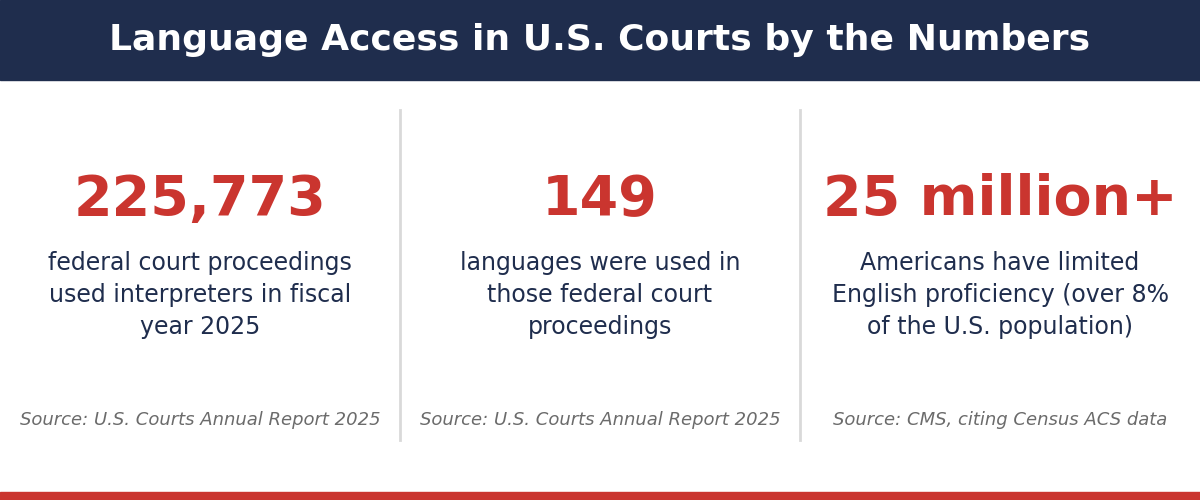
Sources: U.S. Courts Annual Report 2025 and Centers for Medicare and Medicaid Services.
How Courts and Agencies Expect Translations to Be Certified
Many legal settings require more than a translation. In immigration proceedings, for example, 8 CFR 1003.33 requires any foreign-language document offered by a party to be accompanied by an English translation and a signed certification. That certification must state that the translator is competent to translate the document and that the translation is true and accurate to the best of the translator’s abilities.
- A complete English translation of the full document, including stamps and notes
- A signed certification typed or printed legibly
- A statement of the translator’s competence in the language
- A statement that the translation is true and accurate
Rules vary by court, agency, and institution, and not every legal translation needs certification. If your documents are headed for formal submission, our certified translation services provide the correct format once you confirm what the receiving office expects.
Legal Document Types and What Gets Checked
Different documents put different details at risk. This overview shows what our reviewers focus on.
| Document | Typical use | What gets checked closely |
|---|---|---|
| Contract or agreement | Business transactions, employment, vendors | Defined terms, obligations, dates, clause numbering, cross-references |
| Affidavit or declaration | Sworn evidence and supporting statements | Names, dates, statements of fact, signature and notary blocks |
| Court filing or order | Litigation and proceedings | Case numbers, party names, orders, deadlines, citations |
| Power of attorney or will | Estate and representation matters | Scope of authority, beneficiaries, conditions, witness details |
| Corporate documents | Formation, governance, compliance | Entity names, officer titles, voting provisions, registration numbers |
| Official personal records | Family, name change, administrative cases | Names, dates, places, issuing authority, seals |
Why Legal Terminology Does Not Translate Word for Word
Legal language carries meaning that depends on the system it comes from. A faithful translation has to carry that meaning across without adding or removing anything.
Legal Systems Differ by Jurisdiction
Common law and civil law systems build their concepts differently. Terms such as consideration, tort, and trust may have no exact equivalent in another system, so the translator must choose wording that conveys the concept clearly and flag anything that needs a note for the reader.
Defined Terms and Cross-References
Contracts define terms once and rely on them throughout. If one definition is translated two ways, the document can contradict itself. We keep defined terms, section references, and exhibit labels consistent from the first clause to the last.
Obligation and Permission
Words that signal duty, permission, and prohibition must stay precise. The difference between a party who must act and a party who may act changes the legal effect of a clause, so those distinctions are checked line by line.
Our Legal Translation Process
How Our Legal Translation Services Protect Accuracy
Our process is built to support accuracy, confidentiality, and practical usability for sensitive legal content:
- File review and requirements check: We confirm scope, file type, language pair, formatting needs, and intended use.
- Qualified linguists: Your project goes to professionals familiar with legal terminology and document structure.
- Editing and quality review: We check terminology consistency, formatting, and critical details such as names, references, and dates. Added review through translation proofreading and editing is available for high-stakes files.
- Layout preparation: Exhibits, multilingual forms, and structured materials can be matched to the original with desktop publishing services.
- Certification and delivery: Final files arrive in the requested format, with certification options available for official use.
Legal Translation vs. General Document Translation
All legal translation is document translation, but not all document translation is legal translation. Legal materials demand a higher level of precision because wording can affect rights, compliance, deadlines, and how the document itself is read. Our human translation services keep tone, context, and intent intact across document categories.
What to Look for in a Legal Translation Provider
Look beyond whether a provider simply offers translation. Legal content requires the right process, terminology handling, and level of detail.
- Language coverage: Confirm support for the languages and dialects you need. Many cases involve less common pairs, so review the languages we support.
- Legal familiarity: Comfort with document structure, legal vocabulary, and the type of matter involved.
- Quality controls: Review procedures, terminology checks, and formatting accuracy matter when attorneys, courts, or agencies will read the result.
- Official-use support: Make sure certification is available when a translation is submitted formally.
- Professional standards: The American Translators Association (ATA) offers resources on industry expectations and best practices.
- Confidential handling: Ask how files containing sensitive information are stored, shared, and deleted.
The same standards apply across our wider professional translation services for business and personal needs.
How to Prepare Your Legal Documents for Translation
A few steps keep legal projects moving without delays:
- Send editable files when available, along with scans of signed originals
- Include all exhibits, schedules, and attachments
- Share any glossaries, prior translations, or preferred terminology
- Tell us which court, agency, or party will receive the translation
- Note deadlines and whether certification is required
When your files are ready, contact our team for a quote and we will confirm scope, timing, and delivery format.
Legal Document Translation FAQ
What types of legal documents can you translate?
We translate contracts, affidavits, declarations, court-related materials, certificates, personal records, and supporting documents used in legal or administrative matters.
Do you offer certified legal translations?
Yes. If your legal or official documents require certification, tell us the intended use and we will confirm the appropriate delivery format.
How do you ensure accuracy in legal translation?
We use qualified linguists, terminology consistency checks, formatting review, and close attention to names, dates, and references throughout the document.
Can you translate documents for court or litigation?
Yes. We support court-related and legal-supporting materials with attention to structure, terminology, and clarity for practical use.
Do legal translations always need certification?
No. Some translations are for internal, informational, or case-preparation use, while others need certification for formal submission. Requirements depend on the receiving court, agency, or institution.
Can you keep the layout of contracts and exhibits?
Yes. Clause numbering, tables, headers, and exhibit labels can be matched to the original so the translation can be read alongside the source.
How long does legal translation take?
Turnaround depends on document length, language pair, complexity, and formatting requirements. Send the file and we will provide a project-specific timeline.
Get a Quote for Your Legal Documents
When legal documents need to be understood clearly across languages, precision matters. Send us your files and we will provide a project-specific quote and timeline.