

Certified translation services help ensure your documents are ready for immigration, legal, academic, and other official submissions where accuracy, completeness, and presentation matter. When agencies, schools, courts, or employers require translated records, a certified translation provides the translated document along with a signed statement confirming it is complete and accurate to the translator’s best ability.
Etcetera Language Group provides professional certified translations from our Washington, DC team for clients nationwide who need dependable results for high-visibility documents, whether the file is heading to a visa office, a court, or a credential evaluator. We work with qualified linguists across many language pairs and document types, helping clients move forward with official paperwork without the usual uncertainty over formatting, completeness, or certification wording.

What Are Certified Translation Services?
A certified translation includes a signed certification statement confirming that the translation is complete and accurate to the best of the translator’s ability. The certification typically identifies the source document, language pair, translator or provider, signature, and date.
USCIS explains that any foreign-language document submitted with an immigration filing must include a full English translation along with the translator’s certification of completeness and accuracy. Missing or incomplete certification language is one of the more avoidable reasons a filing gets delayed. See USCIS filing guidance on translation certification for the general reference point, or read our primer on what a certified translation is for background in plain English.
Common Documents That Need Certified Translation
Certified translation is often required when a document is reviewed by an institution, agency, court, or evaluator that expects a formal translated version.
Immigration and Government Documents
Birth certificates, marriage certificates, divorce decrees, passports, police records, and affidavits submitted with immigration or government applications. If apostilles are part of your filing, our article on apostille translation services may also help.
Academic and Credential Documents
Transcripts, diplomas, certificates, and supporting educational materials used for admission, evaluation, and employment verification. For transcript-specific needs, see our transcript translation service.
Legal Documents
Court filings, petitions, licenses, powers of attorney, and contracts that require careful terminology and formal presentation, an area our legal translation services support in more depth.
Medical and Official Records
Medical reports, immunization records, consent forms, and diagnostic summaries that may require certification depending on the receiving organization. Our medical translation service covers this specialized content.
What Your Certification Statement Includes
A certification statement is what separates a certified translation from a plain one, and most receiving organizations expect to see the same core elements regardless of document type.
Standard Elements
- Identification of the source document and language pair
- A statement that the translation is complete and accurate
- The translator’s name and signature
Sometimes Required
- Notarization of the translator’s signature
- Company letterhead or a specific statement format
- Additional copies for multiple filing agencies
Requirements vary enough between agencies that it is worth confirming the exact certification format in advance rather than assuming one statement fits every submission you plan to make.
Turnaround for Certified Translation Requests
Standard Requests
Most single certified documents, such as a birth certificate or diploma, are completed within a few business days once we confirm the language pair and certification format needed.
Time-Sensitive Filings
If a court date, visa interview, or admissions deadline is approaching, let us know up front so we can prioritize the file without skipping the review step that keeps it accurate.
When Certification Is Usually Needed
Not every translated document needs certification, but it is commonly required when a translation is being reviewed for official acceptance rather than informal understanding. Agencies and institutions differ in what they will accept, so this is one area where a quick confirmation up front saves a resubmission later.
- Immigration filings: applications, supporting records, and identity documents
- School admissions and evaluations: transcripts, diplomas, and academic records
- Legal matters: court documents, case materials, and formal declarations
- Public benefits or government processes: identity, family, or status-related records
- Employer or licensing review: documents submitted for qualification or verification
If you are unsure whether certification is required, the safest move is to check with the receiving organization before submission, since a missing certification statement is one of the more common reasons paperwork gets sent back for correction and resubmission.
| Situation | Certification Usually Needed? |
|---|---|
| USCIS immigration filing | Yes, required by regulation |
| University admissions transcript | Often, confirm with the school |
| Court filing or legal proceeding | Usually, confirm with the court |
| Internal business communication | Rarely necessary |
| Personal or informal understanding | Not typically required |
Why Certified Translation Matters
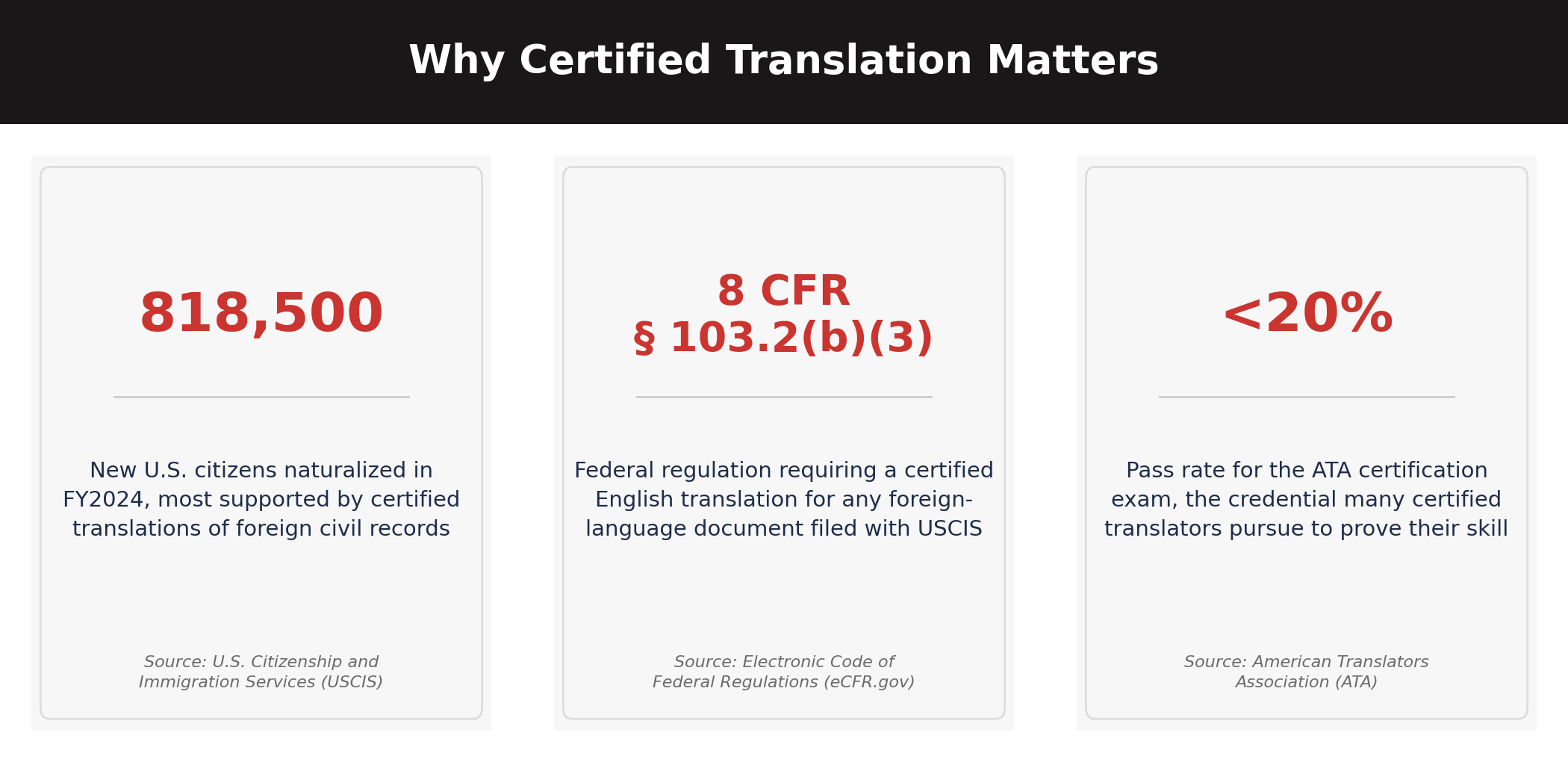
USCIS welcomed 818,500 new citizens during fiscal year 2024, according to USCIS naturalization statistics, and most of those filings depended on certified translations of foreign birth, marriage, or civil records. That requirement is not optional: 8 CFR 103.2(b)(3) requires a certified English translation for any foreign-language document filed with USCIS. The professionals who prepare this kind of work often hold credentials that are genuinely hard to earn: the American Translators Association reports a certification exam pass rate below 20%.
Why Clients Choose Our Certified Translation Services
Official-use translations are often submitted under deadlines, and there is usually not much room for guesswork.
- Readable, natural output: translations read clearly while preserving the source meaning
- Qualified linguists: matched to translators who understand the relevant terminology
- Confidential handling: sensitive documents managed carefully, with NDAs when appropriate
- Formatting awareness: names, dates, stamps, tables, and signatures handled thoughtfully
- Category coverage: immigration, academic, legal, medical, and business files each get different attention
For a related perspective, our article on how to choose the right translation service covers several criteria that also apply when comparing providers for certified work.

What to Look for in a Certified Translation Provider
The language-services world is crowded, and the quality gap between providers can be significant. For high-visibility documents, you want a partner that treats accuracy and accountability as the actual product, not an afterthought squeezed in around faster, cheaper work.
Core Competence
- Translation as a core service: not a side offering bolted onto something else
- Relevant document experience: legal, academic, medical, and civil records each have different expectations
- Clear certification process: the provider understands what a certification statement needs to include
Support Beyond Translation
- Confidentiality support: sensitive legal, financial, or medical files handled with care
- Optional review support: translation proofreading and editing for documents under heavy scrutiny
- Layout support: desktop publishing services when tables, seals, or visual structure must be preserved
Our post on finding a quality translator is another useful resource if you are comparing options.
Our Certified Translation Process
- Document Review: we confirm the source language, target language, document type, and intended use.
- Translator Assignment: your file is matched to an appropriate linguist for the subject matter and language pair.
- Translation and Review: content is translated for completeness, clarity, and consistency.
- Certification Preparation: the translated document is paired with the appropriate certification statement.
- Delivery: you receive the final files in the format needed for submission whenever possible.
Languages We Support for Certified Translation
We work with qualified linguists across many language pairs and document types. Visit our languages overview to confirm availability for your exact combination before you submit anything.
Related Translation Services
Certified translation often overlaps with other language work depending on the document type and the receiving organization’s expectations. Our professional language translation services cover the full range of formats and industries we support. When a project involves a larger set of files that all need to stay consistent, clients often pair certified work with our broader document translation services. For content where tone and readability matter as much as accuracy, our human translation services explain how we match linguists to that kind of work.
Why Choose Etcetera Language Group
- BBB A+ accredited business since 2010
- ATA and NCATA member organization
- Human translators matched to your document type
- Confidential handling of sensitive files
- Family-owned business established in 1996
- Nationwide service from our Washington, DC team
Certified Translation FAQ
What makes a translation certified?
A certified translation includes the translated document plus a signed certification statement confirming that the translation is complete and accurate to the translator’s best ability.
Do you translate documents for immigration and visa applications?
Yes. We regularly translate documents used for immigration filings, visa applications, and other official submissions that require certified translation.
Can you translate academic transcripts and diplomas?
Yes. We translate transcripts, diplomas, and related academic records for admissions, credential evaluations, and official review.
What languages do you support?
We support many language pairs and can confirm availability for your exact document and language combination.
Do you handle formatting and print-ready layout?
Yes. If your translation must preserve layout, tables, stamps, or more complex visual formatting, our desktop publishing team can support that.
Do all official documents require certified translation?
Not always. Requirements vary by agency, school, court, and employer, so it is best to confirm with the receiving organization before submission.
Request a Free Quote
If you need official-use translations handled carefully and delivered with the proper certification, Etcetera Language Group is ready to help with our certified translation services. Contact us to get started.