

Medical translation service support helps healthcare organizations, life sciences companies, and providers communicate clearly across languages when accuracy cannot slip. In medical content, a mistranslated term, dosage instruction, warning, or patient-facing explanation can create confusion, delay care, or introduce avoidable risk.
At Etcetera Language Group, we provide professional medical translation for healthcare and life sciences documents that must stay clear, consistent, and readable in the target language. From patient records and discharge instructions to labeling, instructions for use, and clinical documentation, our human translators handle sensitive content with care and subject-matter awareness.
Modern healthcare is multilingual. Providers serve patients from many linguistic backgrounds, manufacturers distribute products internationally, and research teams work across borders. Accurate translation supports better understanding, safer communication, and more consistent documentation throughout that process.
What Is a Medical Translation Service?
A medical translation service is the professional translation of healthcare, clinical, pharmaceutical, and life sciences content using qualified linguists and a quality-controlled process. Unlike general translation, it requires close attention to terminology, abbreviations, context, formatting, and intended use.
That includes content used by hospitals, clinics, insurers, pharmaceutical companies, device manufacturers, research organizations, and patient support teams. Healthcare is one of the specialized fields covered in our translation services by industry, and the documents involved often contain regulated structures or safety-sensitive instructions that need far more than literal word replacement. For general written materials outside healthcare, our document translation services can support broader file translation.
Translation also plays an important role in research and compliance. Clinical trial documentation, consent forms, patient diaries, and study communications must be clear so participants and research teams understand responsibilities, procedures, and expectations. For background on consent expectations in clinical research, the FDA publishes guidance on informed consent.
Types of Medical Documents We Translate
We support a wide range of healthcare content where precision, readability, and consistency matter. When files also need formal attestation for submission, our certified translation services can add that step.
- Patient records: Visit summaries, medical histories, discharge notes, lab results, imaging reports, and treatment plans
- Pharmaceutical content: Medication guides, inserts, patient information, labeling, and safety communications
- Medical device materials: Instructions for use, manuals, quick-start guides, warnings, and training materials
- Clinical research documents: Informed consent forms, patient diaries, study communications, CRFs, and protocols
- Insurance and reimbursement materials: Appeals, coverage letters, explanations, and supporting medical documentation
- Specialized medical reports: Autopsy reports, diagnostic summaries, and cross-border medical documentation
Why Accuracy Matters in Healthcare Translation
Medical content is not forgiving. The wording must be accurate, the terminology consistent, and the final document understandable to its audience, whether that reader is a physician, patient, caregiver, trial participant, pharmacist, or compliance reviewer.
Common Risks of Poor Medical Translation
- Misunderstood dosage or treatment instructions
- Confusing patient-facing materials that reduce compliance
- Terminology inconsistencies across related documents
- Formatting issues that affect labels, tables, or instructions
- Regulatory or operational delays caused by unclear content
That is why many organizations avoid generic tools and low-context approaches for healthcare content. Experienced human translators read for meaning, tone, and clinical context, which automated output often misses.
Language Access in Healthcare by the Numbers
Millions of people in the United States receive care in a language other than English. A single misunderstood word during an emergency room visit in 1980 led to a $71 million settlement, a case still cited as proof of how much healthcare depends on precise language.
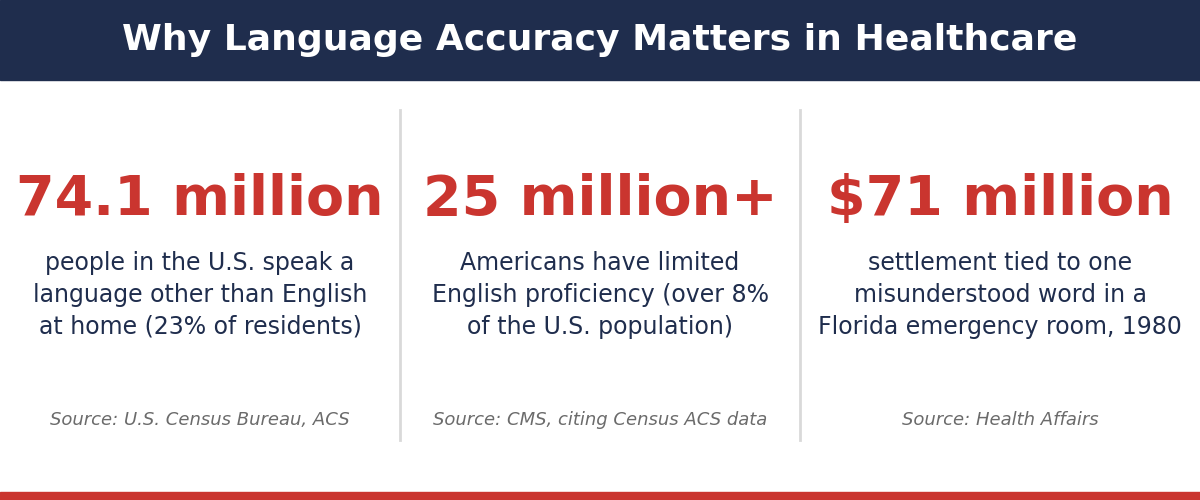
Sources: U.S. Census Bureau language use data, Centers for Medicare and Medicaid Services, and Health Affairs.
Federal Language Access Expectations in Healthcare
Healthcare organizations that receive federal funding must provide meaningful access for patients with limited English proficiency. HHS Office for Civil Rights guidance on Section 1557 explains that covered entities must use qualified translators for written materials, and that machine translation of critical or technical text must be reviewed by a qualified human translator.
For providers, insurers, and manufacturers, that means translation quality is both a safety issue and a compliance issue. Documents that affect rights, benefits, or access to care deserve a documented, human-reviewed workflow.
What to Look for in a Medical Translation Provider
Not every translation company is qualified to handle healthcare content. Evaluate providers on subject-matter knowledge, quality process, confidentiality handling, and their ability to preserve meaning in high-stakes documents.

- Medical subject-matter experience: Look for familiarity with the terminology and document types in your niche, such as oncology, orthopedics, radiology, cardiology, pharmaceuticals, or devices.
- Language-pair support: Confirm the provider covers your source and target languages, including regional variations. See the languages we support for our coverage.
- Defined QA workflow: Review, terminology checks, consistency controls, and formatting verification should be built in.
- Formatting support: Files with tables, diagrams, or packaging elements benefit from desktop publishing services to preserve usability.
- Confidential handling: Ask how files containing patient information are stored, shared, and deleted.
Medical Documents and What Gets Checked Closely
Different documents carry different risks. This overview shows what our reviewers focus on for each type.
| Document | What gets checked closely | Typical readers |
|---|---|---|
| Patient records and discharge instructions | Dosages, dates, units, abbreviations, follow-up instructions | Patients, caregivers, providers |
| Pharmaceutical labeling and inserts | Warnings, contraindications, dosing text, regulated phrasing | Patients, pharmacists, regulators |
| Device instructions for use | Step order, warnings, symbols, part names | Clinicians, technicians, patients |
| Informed consent forms | Plain language, risk statements, voluntary participation wording | Study participants, review boards |
| Insurance appeals and coverage letters | Diagnosis terms, dates of service, policy wording | Payers, patients, reviewers |
| Lab, imaging, and specialized reports | Reference ranges, measurements, anatomical terms | Physicians, specialists |
Our Quality Process for Medical Translation
How Our Medical Translation Service Protects Accuracy
Healthcare translation is not a corner-cutting exercise. The international standard for translation services, ISO 17100, treats independent revision by a second linguist as essential, and a second review is built into every healthcare project we deliver:
- Project intake and scoping: We review file types, audience, terminology needs, and formatting requirements before work begins.
- Translator matching: Content goes to linguists with relevant healthcare or life sciences experience.
- Terminology control: Repeated medical terms, instructions, and phrasing stay consistent across files.
- Editing and review: A second linguist checks meaning, clarity, and accuracy before delivery.
- Formatting verification: Tables, headings, labels, and layout are checked so the file stays usable and professional.
- Optional polishing: High-visibility files can add translation proofreading and editing as a final quality step.
Translation for Labeling, Devices, and Patient Safety
Many healthcare documents exist to help people use medicines or devices correctly. That includes patient labeling, instructions for use, package inserts, and other product-facing content where clarity is directly tied to comprehension. The FDA offers background on product labeling, and translations must preserve the meaning of every warning and instruction.
Dosages, Units, and Number Formats
Small formatting differences can change meaning. Many regions write decimals with commas instead of periods, date orders vary, and measurement units differ. We keep numbers, units, and dosing language exactly aligned with the source and flag anything ambiguous before delivery.
Patient-Facing Readability
Materials written for patients should be easy to follow. We adapt phrasing so instructions stay clear for general readers, without simplifying away clinical meaning.
Some healthcare projects also involve consent, malpractice, or compliance records. For those files, our legal translation services can support the legal side of the same workflow.
Clinical Research and Study Materials
Sponsors and research teams need participants to understand what they are joining. Consent forms, patient diaries, questionnaires, and investigator materials must be translated with consistent terminology across every document in the study. Study sponsors and review boards may require additional verification steps, so share those requirements early to avoid delays.
How to Prepare Your Medical Files for Translation
A few simple steps keep projects moving quickly:
- Send editable files when available, along with scanned originals for reference
- Include glossaries, approved terminology, or previous translations
- Identify the audience, such as patients, clinicians, regulators, or participants
- Note the target region so we can match dialect and units
- Flag any deadlines, review steps, or submission requirements
When your files are ready, contact our team for a quote and we will confirm scope, timeline, and delivery format.
Healthcare Translation FAQ
How fast can you deliver medical translations?
Turnaround depends on file length, complexity, language pair, and formatting requirements. We review the project first and confirm timeline, cost, and delivery format before work begins.
Do you translate clinical trial informed consent documents?
Yes. These documents need clear language and precise meaning so participants understand what they are agreeing to and what the study involves. If a sponsor or review board has specific requirements, share them at the start.
Can you preserve the original formatting, tables, and layout?
Yes. If your file needs to match the original design or structure, we align the translation with your formatting requirements and prepare the final file for print or digital use.
Do you translate recorded interviews and consultations?
Yes. We can translate transcripts of recorded patient consultations, research interviews, and focus groups. Send us the transcript or recording details and we will confirm the best approach.
What languages do you support?
We support more than 100 languages and can confirm coverage for your specific language pair. Contact us with your project details and we will respond with options.
Can machine translation be used for patient materials?
Automated tools can help with low-risk content, but critical, technical, or patient-facing medical text should be reviewed by a qualified human translator. Federal Section 1557 rules require that review for critical material at covered healthcare organizations.
Why is medical translation different from general translation?
Medical translation involves specialized terminology, safety-sensitive instructions, clinical context, and higher consequences for error. It requires subject-matter knowledge in addition to language fluency.
Get a Quote for Your Medical Documents
Accurate, consistent translation keeps patients safe and projects on schedule. Send us your healthcare, device, or clinical files and we will provide a clear plan for your timeline and delivery needs.