

Immigration translation services are essential when birth certificates, marriage certificates, passports, academic records, police clearances, and other official documents must be submitted in English for immigration purposes. The process leaves very little room for error. Names, dates, places of birth, document numbers, and official wording all need careful handling so the translated version is clear, complete, and ready for review.
At Etcetera Language Group, our human translators support individuals, families, attorneys, and organizations with accurate translations for immigration paperwork, and we have done so since 1996.
What Are Immigration Translation Services?
Immigration translation involves translating the official records and supporting documents used for visa applications, residency petitions, citizenship filings, family sponsorship cases, and other immigration matters. The translation must reflect the original accurately while preserving names, stamps, dates, formatting, and other identifying details as closely as possible.
- Filings often include several document types from different countries and institutions
- Official records may contain handwritten notes, seals, signatures, or nonstandard formatting
- Small inconsistencies in names, dates, or document details can cause confusion or delays
- Many applications require a complete, readable translation that an agency, attorney, or institution can review with confidence
This work is not simply swapping words from one language to another. It is delivering a clear, faithful version of the original so the reader understands the information exactly as intended. It is one of several specialized fields covered in our translation services by industry, and general records outside an immigration filing fall under our document translation services.
Common Immigration Documents We Translate
Immigration cases often combine personal, legal, academic, and civil records, and a case may need one translation or an entire application package. Court records and affidavits can also draw on our legal translation services.
- Birth Certificates: Often required for identity verification, family petitions, and citizenship applications.
- Marriage Certificates and Divorce Decrees: Needed to document marital status, family relationships, or prior legal changes.
- Passports and National ID Documents: Support names, dates of birth, nationality, and document numbers.
- Police Certificates and Background Records: Required in some processes from one or more countries.
- Academic Records: Diplomas, transcripts, and certificates for student visas, evaluations, or employment-related matters.
- Court and Legal Documents: Name change records, custody paperwork, affidavits, and supporting filings.
- Medical and Vaccination Records: Requested for some applications or appointments.
- Employment and Financial Documents: Letters, pay records, and tax documents that prove work history or income.
Every case is different, so we review the file type, language pair, intended use, and certification needs before work begins.
Why Accuracy Matters for Immigration Documents
Immigration paperwork depends on consistency. A mismatch between a source document and its translation can trigger questions, requests for clarification, or submission problems.
- Names stay consistent: Different spellings, missing middle names, or formatting differences create confusion across documents
- Dates and places are exact: Birth, issue, and expiration dates and locations must be presented correctly
- Translations are complete: Leaving out seals, handwritten notes, or stamped content weakens the final file
- Presentation is clear: The document should be organized for practical review

Immigration and Naturalization by the Numbers
Immigration touches millions of households, and every foreign-language record in a filing needs a reliable English version. The foreign-born population in the United States is roughly one in seven residents, and hundreds of thousands of people complete naturalization each year.
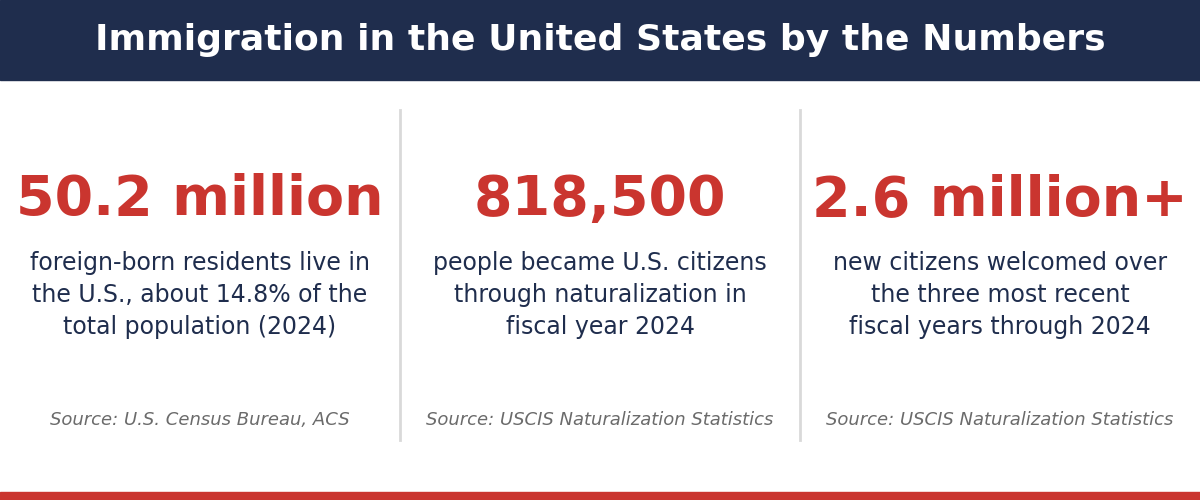
Sources: U.S. Census Bureau foreign-born population data and USCIS naturalization statistics.
Federal Translation Requirements for USCIS Filings
Federal rules set a clear standard for foreign-language evidence. Under 8 CFR 103.2(b)(3), any document in a foreign language submitted to USCIS must come with a full English translation, plus the translator’s certification that the translation is complete and accurate and that the translator is competent to translate from the foreign language into English.
In practice, a complete submission typically includes:
- A full translation of every element, including stamps, seals, and handwritten notes
- A signed and dated translator certification of accuracy and completeness
- A statement of the translator’s competence in both languages
- A copy of the original document alongside the translation
The regulation asks for the translator’s certification and does not mention notarization. Other agencies and institutions may set their own rules, so confirm what your receiving office expects.
Documents Often Needed for Immigration Cases
Some matters are straightforward, while others require a detailed package of supporting records. This overview shows common documents, their typical use, and the details we verify.
| Document | Typical use | Details we verify |
|---|---|---|
| Birth certificate | Family petitions, identity, citizenship | Full names, parents’ names, date and place of birth, registry numbers |
| Marriage certificate | Spouse and fiance petitions | Both spouses’ names, date and place of marriage, issuing authority |
| Divorce decree | Proof of prior marital status | Case numbers, dates, court names, final judgment wording |
| Passport or national ID | Identity and nationality | Name spelling, document numbers, issue and expiration dates |
| Police certificate | Background review | Issuing agency, date range covered, official statements |
| Academic records | Student, work, and evaluation matters | Course titles, grades, degree names, dates |
| Court and custody documents | Family and legal status cases | Parties, orders, case numbers, signatures and seals |
School records often need their own handling, and our academic transcript translation keeps course lists, grades, and credits clear for evaluators and immigration reviewers.
Our Process for Immigration Document Translation
How Our Immigration Translation Services Work
We use a practical process built around clarity, completeness, and reliable delivery:
- File review: We review document type, language pair, formatting, and intended use.
- Project assignment: Your files go to qualified linguists familiar with official and administrative documents.
- Detail checks: Names, dates, locations, stamps, and reference numbers are reviewed carefully.
- Certification when needed: If your receiving office requires a certified translation, we provide the appropriate format.
- Final delivery: We deliver finished files in the agreed format so you can move forward with submission.

Certified Translation for Immigration Documents
Many submissions need more than a standard translation. The translation may require a certification statement confirming that it is complete and accurate, which is common for civil records and other supporting paperwork in formal filings.
Not every document needs identical handling, so it helps to know where the file is going and what the receiving agency expects. Our certified translation services cover that step when it is required.
Names, Dates, and Transliteration in Immigration Records
Identity details are a common source of mismatches in a filing, so we treat them with extra care.
- Name spelling: Names written in non-Latin scripts can be transliterated several ways, so we match the spelling on your passport or other primary identification.
- Multiple surnames: Many cultures use two surnames or patronymics, and we keep each part in the right position.
- Date formats: Day-month-year and month-day-year orders differ across countries, so dates are written unambiguously.
- Place names: Cities and regions may have changed names or spellings, and we keep references consistent across documents.
Who Needs Translated Immigration Documents
Individuals and Families
Marriage-based, family-based, citizenship, and residency paperwork.
Attorneys and Legal Teams
Organized, readable translated records that support a client’s filing.
Students and Researchers
Visa, enrollment, and academic document review.
Employers and HR Teams
Work-related immigration involving education or identity records.
Sponsors and Petitioners
Relatives and sponsors who submit civil records for family cases.
Agencies and Organizations
Relocation support and multilingual program documentation.
Student cases often involve school records, and our translation services for universities and education cover transcripts, diplomas, and enrollment documents in depth.
How to Prepare Your Immigration Documents
A little preparation keeps your case moving:
- Scan every side of each document in color at a readable resolution
- Include seals, stamps, signatures, and handwritten notes
- Confirm the name spelling on your passport and send a copy
- Tell us which agency or office will receive the translation
- Note any deadlines, such as appointment or filing dates
When your files are ready, contact our team for a quote and we will confirm scope, timing, and certification needs.
What to Look for in a Translation Provider for Immigration
Choose a provider on accuracy and document handling, not price alone. The right partner supports official-use needs without turning the process into guesswork.
- Experience with official documents: Certificates, legal records, and administrative paperwork need careful handling
- Certification support: Confirm certified translation is available
- Attention to formatting: Names, dates, seals, and signatures should be reviewed closely
- Broad language coverage: Cases may involve uncommon languages, so check the languages we support
- Clear communication: You should know what is needed, what you will receive, and when
Our human translators read every document in context, and our wider professional translation services support related business and personal needs.

Immigration Document Translation FAQ
What documents usually need translation for immigration?
Common examples include birth certificates, marriage certificates, divorce decrees, passports, police records, academic transcripts, diplomas, court documents, and other supporting records required for an application or review.
Do immigration documents need certified translation?
For filings with USCIS, federal rules require a full English translation with the translator’s certification that it is complete and accurate and that the translator is competent in both languages. Other agencies and institutions may set their own requirements, so confirm the destination before ordering.
Does USCIS require a notarized translation?
The federal regulation asks for the translator’s certification and does not mention notarization. Some receiving offices ask for additional steps, so check the instructions for your specific form or request.
Can you translate birth certificates and marriage certificates for immigration?
Yes. We regularly translate civil records such as birth certificates, marriage certificates, divorce decrees, and other official personal documents used for immigration matters.
How do you help ensure accuracy?
We review names, dates, places, stamps, signatures, and formatting carefully, and we assign the work to qualified linguists experienced with official documents.
Can you translate academic records for student or work-related immigration?
Yes. We translate transcripts, diplomas, certificates, and other school records that may be needed for student, employment, or evaluation-related immigration matters.
How long do immigration translations take?
Turnaround depends on the size of the document set, the language pair, file quality, and whether certification is needed. Send us your files and we will provide a project-specific timeline.
Get a Quote for Your Immigration Documents
Clear, accurate translations help your filing move forward with fewer delays. Send us your records and we will provide a project-specific quote and timeline.