

Education translation services for universities turn transcripts, diplomas, enrollment records, and institutional materials into clear, accurate translations without changing what the original says. Admissions offices, credential evaluators, registrars, and international student offices rely on those translations to make fair decisions, so every grade, date, and course title has to be right. At Etcetera Language Group, our human translators have supported students, schools, and organizations since 1996 with academic translations that are consistent, carefully formatted, and ready to submit.
Whether you are a single applicant preparing a transfer file or a university translating program materials for a multilingual audience, the goal is the same: a translation that the reader can review quickly and trust completely.
Education Translation Services for Universities: What We Cover
Academic translation means converting records and communications from one language to another while preserving meaning, structure, and context. A translated transcript should look and read like the original, with the same course order, credit values, grading notations, and institutional details.
- Academic records must reflect course names, grades, and credits accurately
- Institutional documents often include specialized terminology that needs consistent handling
- Formatting and structure must stay aligned with the original for evaluation or submission
- Clear communication supports admissions, enrollment, and program participation
- Seals, stamps, signatures, and handwritten notes need to be described, not skipped
Academic and Institutional Documents We Translate
Needs vary widely, from a single diploma to a full academic portfolio. For broader academic materials beyond student records, our document translation services cover manuals, handbooks, and administrative paperwork.
- Academic Transcripts: Course lists, grades, GPA notations, and credit hours translated clearly for evaluation or admissions review.
- Diplomas and Certificates: Degree titles, majors, honors, and issuing institutions represented accurately.
- Enrollment and Attendance Records: Verification of study periods, program participation, and institutional history.
- Letters of Recommendation: Supporting materials where tone and intent must be handled with care.
- Research and Academic Papers: Articles, abstracts, and studies prepared for international collaboration.
- Student Records: Identification, academic standing, and administrative documentation.
- University Communications: Admissions materials, program descriptions, and student-facing information.
- Training and Course Materials: Syllabi, guides, and learning content for multilingual audiences.
Why Accuracy Matters in Academic Translation
Educational documents are used for admissions decisions, credit transfer, scholarship review, and credential verification. Small inconsistencies can change how a record is interpreted. The American Association of Collegiate Registrars and Admissions Officers publishes guidance on academic records and admissions practices that many institutions follow, and a translation should never create questions that the original record did not raise.
- Clear course names and grades: Misreadings can affect evaluations and decisions
- Consistent terminology: Academic terms stay uniform across the entire record
- Preserved structure: Tables, grading scales, and layouts mirror the source
- Readable presentation: Reviewers can scan the document without confusion
If your records are going to a registrar or evaluator, certified translation for university admissions is often required.

Education and Language Access by the Numbers
International enrollment and multilingual school communities keep demand for accurate academic translation steady. U.S. colleges hosted more than 1.1 million international students in 2024/25, and public schools serve millions of students who are still learning English. Each of those students has records, forms, or family communications that may need to cross a language barrier.
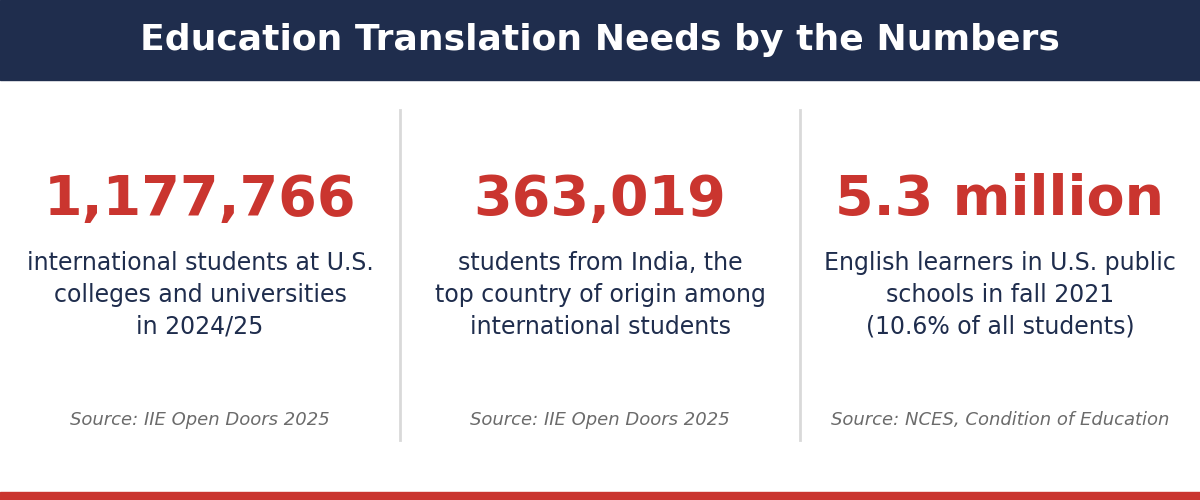
Sources: Institute of International Education Open Doors 2025 Fast Facts and National Center for Education Statistics English learners data.
What Must Carry Over in Common Academic Records
Different records carry different risks. This overview shows the details we check most closely for each document type.
| Document | Details that must carry over | Typical use |
|---|---|---|
| Transcript | Course titles, grades, credits, term dates, grading scale, institution name | Admissions, transfer credit, credential evaluation |
| Diploma or degree certificate | Degree title, major, honors, date conferred, signatories, seals | Admissions, employment, licensing |
| Enrollment verification | Dates of attendance, program, status, official statements | Visa support, scholarships, employers |
| Letter of recommendation | Tone, relationship to the applicant, specific achievements | Admissions and scholarship review |
| Course description or syllabus | Learning outcomes, credit hours, assessment methods | Transfer credit and equivalency decisions |
| Research abstract or paper | Technical terms, citations, data labels, units of measure | Publication and academic collaboration |
Who Relies on Academic Translation
Students
Applicants and transfer students submit credentials to schools in another country and need records that read cleanly the first time.
Universities and Colleges
Admissions, registrar, and international offices manage multilingual communications and incoming records.
Credential Evaluators
Evaluation services review records from many education systems and depend on faithful, well-structured translations.
Researchers and Faculty
Scholars share papers, grant materials, and course content with international colleagues and publishers.
Employers and Licensing Boards
Hiring teams and professional boards verify degrees and coursework earned abroad.
Applicants Abroad
Students moving for study often need academic records alongside visa paperwork and other official documents.
When school records are part of a visa or status filing, our immigration translation services for student visa applicants can support the full set of documents.
Our Process for Translating Academic Records
How We Deliver Education Translation Services for Universities
We follow a structured workflow built for clarity, consistency, and dependable delivery:
- Document review: We check file types, language pairs, formatting, and the intended use of each record.
- Qualified linguists: Your documents go to human translators familiar with academic terminology and formatting.
- Detail checks: Course names, grades, dates, credit values, and tables are verified against the source.
- Certification when needed: A signed statement of accuracy is available for transcripts and official records.
- Final delivery: Files arrive in a format ready for submission, evaluation, or archiving.

Transcript and Diploma Translation
Transcripts are among the most requested academic documents. They combine course titles, grades, credit hours, and institutional formatting that must stay clear and complete. Our academic transcript translation supports students and institutions that need dependable translations for admissions, transfer credit, or verification.
Diplomas follow the same discipline. Degree names, honors, and dates are translated precisely, and decorative elements such as seals and crests are noted so the reviewer knows the translation reflects the full document.
Certified Translation for Admissions and Credential Review
Many schools, evaluators, and agencies ask for a certified translation, meaning the translator confirms in writing that the work is complete and accurate. Federal rules for USCIS filings, found in 8 CFR 103.2(b)(3), require a full English translation with the translator’s certification of competence. Universities and evaluation services set their own standards, so it pays to confirm what the receiving office expects before you order.
Credential evaluators, including members of the National Association of Credential Evaluation Services, generally assess foreign education against U.S. standards. Their review starts with the documents you submit, which is why a clear translation matters. We deliver translations in a clean, consistent layout that evaluators can read without follow-up questions.
How to Prepare Your Documents for Translation
A little preparation prevents delays and rework. Before you send files, run through this checklist:
- Scan every side of each document in color at a readable resolution
- Include seals, stamps, signatures, and any handwritten notes
- Send the complete record, including grading scale keys and the reverse side of each record
- Note the spelling of names exactly as they appear on your passport
- Tell us who will receive the translation and whether certification is required
- Share any institution-specific instructions from the receiving office
Once your files are ready, request a quote for your academic documents and we will confirm scope, language pair, and timing.
Translation for University Communications and Outreach
Universities communicate with prospective students and families in many languages. Admissions brochures, program guides, scholarship notices, and student handbooks all benefit from translations that sound natural to the reader while keeping official terms exact.
Print and digital materials also need careful layout. Our multilingual desktop publishing keeps translated brochures and guides polished, even when text expands or the script changes direction. A final round of translation proofreading and editing adds another check for tone, terminology, and consistency before anything is published.

Languages and Regional Variations in Academic Records
Academic records vary by country as much as by language. We translate between English and more than 100 languages, and our linguists pay attention to how each education system structures its documents.
Names, Dates, and Transliteration
Names written in non-Latin scripts can be transliterated in more than one way, and date formats differ across regions. We keep spellings consistent with your passport or other official identification and write dates in a clear, unambiguous format.
Grading Scales and Credit Systems
Translation preserves grades exactly as the issuing school recorded them. Converting a foreign grade to a U.S. GPA equivalent is typically the work of a credential evaluation service, not the translator. We note grading scales and credit systems so evaluators have the context they need.
What to Look for in an Academic Translation Provider
When choosing support for academic translation, focus on accuracy, clarity, and consistency rather than speed alone.
- Experience with academic documents: Transcripts, diplomas, and institutional materials require familiarity with education systems
- Formatting accuracy: Tables, grading scales, and course structures should remain easy to read
- Language coverage: Academic cases often involve multiple languages and regional variations
- Certification support: Required for official submissions in many cases
- Clear communication: Understanding your requirements up front prevents delays
Education is one of many sectors we support, from translation services by industry to broader professional translation services for business and government clients.
FAQs About Academic and University Translation
What academic documents do you translate?
We translate transcripts, diplomas, degree certificates, enrollment and attendance records, letters of recommendation, course descriptions, research papers, and university communications used for admissions, evaluation, or verification.
Do transcripts need certified translation?
In many cases, yes. Universities, credential evaluators, and government agencies often require a translation that comes with a signed statement of accuracy and completeness. Requirements depend on the receiving institution, so confirm them before you order.
Can you translate diplomas and degree certificates?
Yes. We translate diplomas, degree certificates, and other academic credentials, preserving degree titles, majors, honors, dates, and the names of issuing institutions. Seals, stamps, and signatures are described in the translation.
Do you convert foreign grades to a U.S. GPA?
Translation keeps grades and grading scales exactly as the original issued them. Converting grades to a U.S. equivalent is usually done by a credential evaluation service, and we can deliver translations in the format those services expect.
How long does academic translation take?
Turnaround depends on document length, complexity, and language pair. A single transcript moves faster than a full set of program materials. Send your files for a project-specific timeline.
Can you translate research papers and university materials?
Yes. We translate academic papers, program descriptions, admissions materials, student handbooks, and course content for international audiences, and we can match the original layout for print or digital use.
What file formats can I send?
You can send scanned PDFs, photos, Word files, spreadsheets, and design files. Clear, complete scans that show every stamp, seal, and margin note help us deliver an accurate translation the first time.
Get a Quote for Your Academic Documents
Accurate translation makes admissions, evaluation, and verification smoother for everyone involved. Send us your transcripts, diplomas, or university materials and we will provide a clear, project-specific quote.