

For more than 27 years, Etcetera Language Group has provided document translation services for individuals, businesses, and institutions across the United States and around the world. From legal records and medical files to academic transcripts, business contracts, and technical manuals, our translators work to keep every detail, term, and formatting choice intact so a translated file is ready for its intended purpose the moment it lands in someone’s hands.
Document translation is about far more than swapping words from one language for another. It requires preserving meaning, terminology, tone, and usability so the finished file holds up for official submission, internal business use, or client-facing delivery. Our approach is grounded in the standards recognized by the American Translators Association, and every project is supported by our family-owned team’s translation memory and terminology tools to keep wording consistent across long or repeated documents.

Professional Document Translation Services in 100+ Languages
We translate documents to and from English in more than 100 languages, including Spanish, French, German, Arabic, Japanese, Russian, Portuguese, and dozens more. Whether it is a single personal record prepared for a government office or a large batch of business files needed for multilingual communication, our linguists work to protect the clarity, terminology, and intent of the original text from the first line to the last.
If your project calls for a specific language pairing, you can browse our full list of language pairs we support to confirm we cover the languages your documents require.
What Types of Documents Can We Translate for You?
Our document translation services cover a wide range of file types across business, legal, medical, academic, and technical categories. Some of the documents we handle most often include:
- Legal documents: contracts, affidavits, court filings, certificates, and compliance records, the kind of work covered in depth by our legal translation services
- Medical documents: patient records, clinical reports, device instructions, and healthcare paperwork, which our medical translation services are built around
- Academic documents: transcripts, diplomas, enrollment records, and supporting education files
- Business documents: proposals, reports, presentations, and internal communications
- Technical documents: manuals, specifications, product instructions, and process documentation
- Personal records: birth certificates, marriage certificates, identity documents, and immigration paperwork
Clients working through immigration paperwork often ask about our certified birth certificate translation process.
Certified and Notarized Translation for Official Documents
Some projects need a formal certification before they can be submitted to a school, agency, court, or other institution. We provide certified translation services for many types of official records, and notarized translations are available on request. Federal regulation 8 CFR § 103.2(b)(3) requires that any foreign-language document filed with U.S. Citizenship and Immigration Services be accompanied by a full English translation along with the translator’s signed certification of accuracy and competency, so getting this step right matters well beyond simple readability.

International filings sometimes call for an additional step covered in our guide to apostille translation requirements.
Why Document Translation Services Must Be Accurate
A missed detail, an inconsistent term, a formatting slip, or an awkward phrase can change the meaning of a document, delay an approval, confuse the reader, or undercut trust in the file itself. Reliable document translation services focus on both linguistic accuracy and practical usability, which means paying attention to:
- Terminology consistency: key terms stay uniform from the opening section to the closing line
- Meaning preservation: the translated version reflects intent, not just individual words
- Formatting control: headings, lists, tables, and layout stay clear and usable
- Readability: the finished document sounds natural to a native reader
Document Translation Demand in the United States
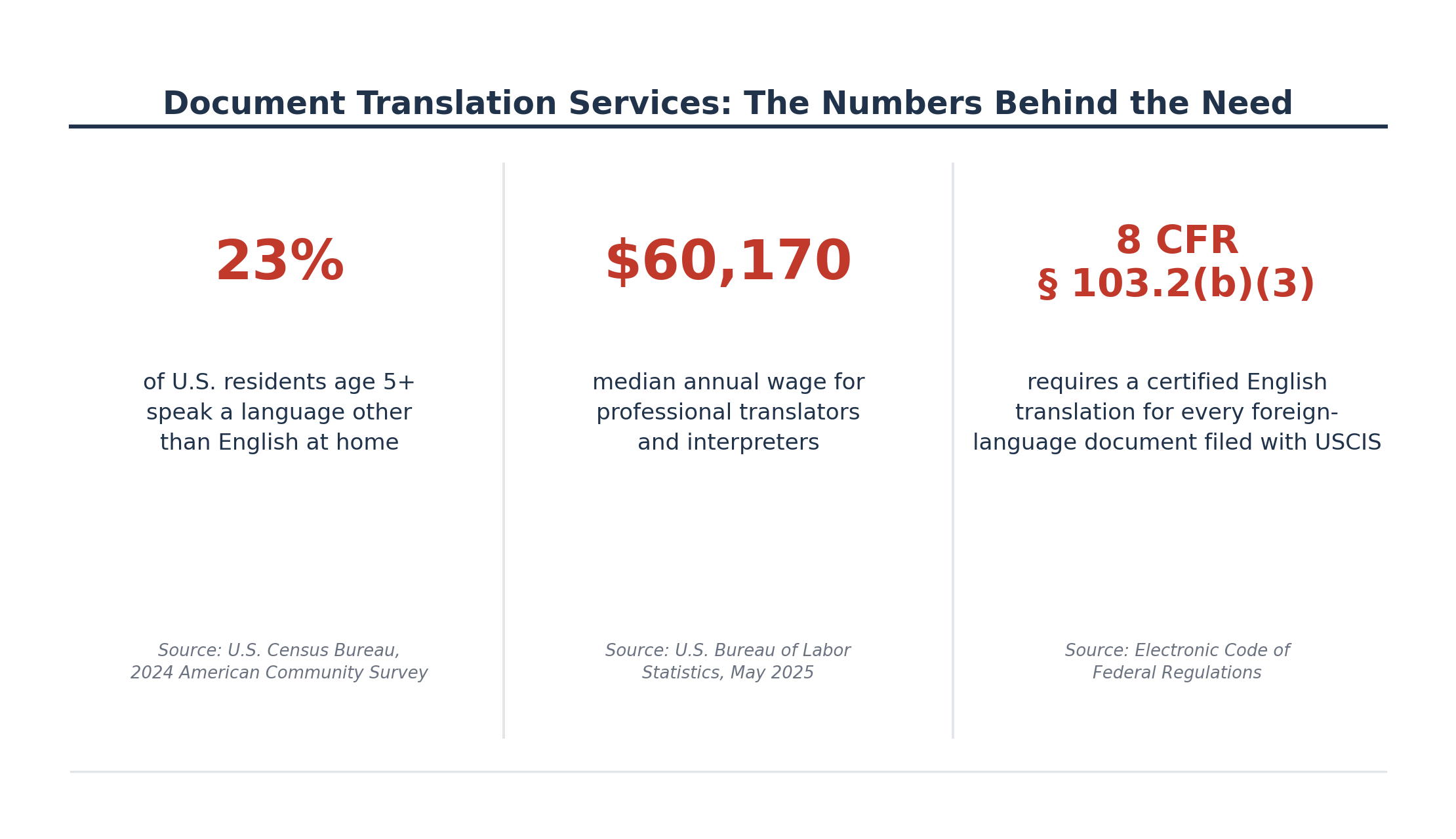
The need for accurate, professionally handled document translation services keeps growing alongside the country’s linguistic diversity. According to 2024 Census Bureau data, roughly 23 percent of U.S. residents age 5 and older, about 74.1 million people, speak a language other than English at home. That demand supports a dedicated workforce: the U.S. Bureau of Labor Statistics reports a median annual wage of $60,170 for translators and interpreters as of May 2025, with several thousand new openings projected each year. On the regulatory side, the certified-translation requirement discussed above means document translation is not optional for anyone submitting foreign-language paperwork to a federal agency.
Human Expertise vs. Machine Translation for Documents
Where Human Expertise Matters Most
Documents are a different challenge than casual conversation. Contracts hinge on precise legal phrasing, medical files depend on exact clinical terminology, and academic records need consistent formatting that a receiving institution will recognize. That level of precision is exactly why professional translation services outperform free tools for anything that carries legal, medical, or academic weight.
Where Automation Still Falls Short
Free translation tools have gotten better at handling everyday text, but they frequently misread context, flatten nuance, or mistranslate specialized vocabulary in ways that are easy to miss unless a qualified human reviews the output line by line. We use professional-grade CAT tools and terminology management systems to keep wording consistent, but we do not let software make the final call. Every document passes through a human translator and a separate editor before it reaches you.
Our Document Translation Process
Our workflow is built to support accuracy, clarity, and dependable turnaround across a wide range of file types and subject areas:
- Document review and project assessment
- Assignment to a qualified linguist with relevant subject-matter experience
- Translation with close attention to terminology and intent
- Independent editing and proofreading for quality assurance
- Formatting, certification when required, and final delivery
Turnaround Times for Document Translation
Turnaround naturally varies by document length, subject complexity, language pair, and whether certification is required. A short personal record, such as a single birth certificate or diploma, can often move through translation, review, and certification within a day or two. Longer files, technical manuals, or projects involving less common language pairs typically need additional time so that terminology research and quality review can be done properly rather than rushed. When a deadline is tight, letting our team know upfront allows us to plan the timeline realistically instead of discovering constraints midway through the work.
Projects involving complex layouts, multilingual design files, or brochures often benefit from our desktop publishing services, which help preserve the visual structure of the original file in the translated version. High-quality document translation also usually includes a separate editing and proofreading pass to catch inconsistencies and confirm structure before final delivery. Our translation proofreading and editing service exists for exactly this reason, giving every document a second set of expert eyes before it reaches you.
Who Relies on Professional Document Translation
Clients come to us from legal practices, hospitals and clinics, universities, manufacturers, and immigration attorneys, among many others. Each of these fields brings its own vocabulary, formatting expectations, and margin for error, so a translator working on a patent application needs a different frame of reference than one working on a hospital discharge summary. Matching the right linguist to the right subject matter is one of the quieter but more important parts of getting a document translation right the first time.
Academic institutions in particular tend to need our transcript translation services for enrollment records and credential evaluations, while manufacturers and technology companies more often need product documentation, safety data sheets, and user manuals handled with the same precision. For a broader look at everything we offer beyond document translation, our professional language translation services overview covers the complete lineup.
Why Choose Etcetera Language Group for Document Translation
- More than 27 years of experience, family-owned since 1996
- Support for 100+ languages
- Certified and notarized translation options
- Quality-focused editing and proofreading built into every project
- Confidential handling of sensitive legal, medical, and personal documents
- Consistent terminology maintained through professional translation memory tools

FREE BROCHURE: Have International Clients? Look Professional by Hiring Professionals!
Discover why more businesses are turning to Etcetera Language Group for translation services – excellence isn’t something we strive for, it’s something we provide.
Document Translation FAQs
What types of documents can you translate?
We translate legal, medical, academic, technical, business, and personal documents, including contracts, certificates, records, manuals, reports, and forms.
Do you offer certified document translation services?
Yes. We provide certified translations for many official and institutional uses, and notarized options are available depending on your project’s requirements.
How long does document translation take?
Turnaround depends on document length, language pair, subject complexity, and formatting needs. Shorter files can often be completed quickly, while larger or specialized projects require more time.
Can you translate scanned or image-based documents?
Yes. We can work with scanned documents, PDFs, and image-based files, and we can often preserve or recreate the original formatting.
Do you preserve the original formatting?
Yes. We aim to maintain the original layout and structure whenever possible, which matters most for documents that need to stay easy to compare against the source.
How do you protect confidentiality?
Sensitive files are handled carefully, and confidentiality procedures are followed throughout the process, since many legal, medical, business, and personal documents require secure handling.
Request a Free Quote
If you need accurate document translation for legal, medical, academic, business, or official use, Etcetera Language Group is ready to help. You can request a free quote through our contact team or call (202) 769-4814 to discuss your project.