Which Language Has the Most Words & Other Fun Facts
The world’s languages are endlessly fascinating, and not just in how they sound. From the sheer number of words to the complexity of their writing systems, every language holds its own surprising records. Whether you’re a language enthusiast, a student, or someone who regularly works with professional translation services, these facts offer a striking window into just how varied human communication really is.
- Most words: English (~615,100 in the Oxford English Dictionary)
- Most native speakers: Mandarin Chinese (~955 million)
- Largest alphabet: Khmer/Cambodian (74 letters)
- Most characters: Chinese (50,000+)
- Most tones: Wobé, spoken in the Ivory Coast (up to 14 tones)
- Hardest for English speakers: Arabic, Chinese, Japanese, and Korean (FSI Category IV)
Which Language Has the Most Words?
Languages vary greatly in terms of their word count. It’s difficult to get an exact figure for any language, but according to World Atlas, English is widely considered the leader when it comes to sheer vocabulary size.
Counting words is surprisingly tricky for a number of reasons. One major complication is that many words serve multiple grammatical functions: the word “run,” for example, can function as both a noun and a verb. Compound words add further complexity. However, major dictionaries offer a reasonably consistent way to measure word counts. Using the Oxford English Dictionary as a benchmark, English contains approximately 615,100 words.
Part of what makes English’s vocabulary so expansive is its history as a language. English has drawn heavily from Latin, French, Germanic, and Norse roots, and continues to absorb loanwords from hundreds of other languages. This means there are often multiple words for the same concept, a feature that makes English both rich and occasionally redundant.
For translators, a large vocabulary can be both an asset and a challenge. When translating into English, there is usually a precise word available for even subtle distinctions. When translating from English, however, those distinctions may not exist in the target language, requiring skilled document translators to find culturally appropriate equivalents rather than direct substitutions.
Which Language Has the Most Native Speakers?
English’s vocabulary count may lead the pack, but its native speaker count does not. That honor goes to Mandarin, a widespread form of Chinese, according to Uniglobe.
Mandarin owes its enormous speaker count largely to its status as the official dialect of both China and Taiwan, two of the world’s most populous countries. It is also one of Singapore’s four official languages. In all, Mandarin has approximately 955 million native speakers, nearly three times the entire population of the United States, and roughly 14.4 percent of all people on Earth.
Spanish and English rank second and third respectively on Uniglobe’s native-speaker list. Hindi/Urdu and Arabic round out the top five. Taken together, these five languages are spoken natively by well over two billion people a fact that has significant implications for global communication and industries that rely on multilingual outreach.
It’s also worth noting that the number of total speakers (native plus second-language) tells a different story. By that measure, English is actually the most widely spoken language in the world, with over 1.4 billion total speakers. Explore all of the languages we translate to see the full range of options available.
Which Language Has the Largest Alphabet?
Alphabets are another area where languages diverge dramatically. In an alphabet, each symbol typically corresponds to a single sound, as explained by Angmohdan.
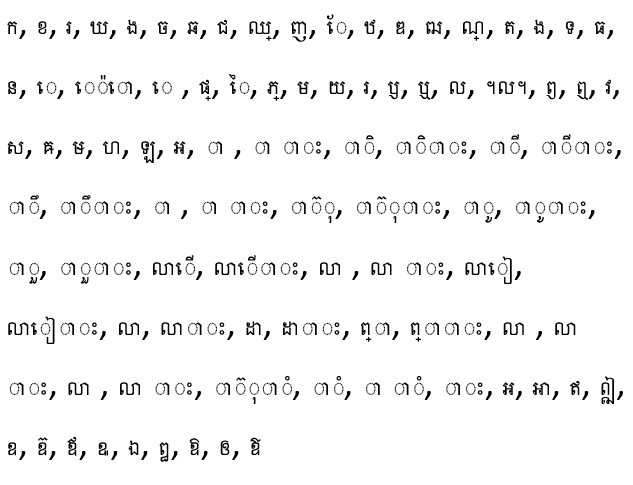
English speakers are likely familiar with their own 26-letter alphabet, but that number barely registers next to the world’s largest, which belongs to Khmer, more commonly known as Cambodian. Khmer boasts a total of 74 letters, made up of 33 consonants, 23 vowels, and 12 independent vowels. To put that in perspective, Khmer has more consonants alone than English has total letters.
Khmer is the official language of Cambodia and is also spoken in parts of Thailand and Vietnam. Its script has roots in southern India and has appeared in written form since the 7th century, making it one of the world’s older continuous writing systems. For organizations working in Southeast Asia or with Cambodian immigrant communities, accurate Khmer to English translation requires a specialist, as both the script and grammar differ fundamentally from European languages.
Which Language Has the Most Characters?
Not all languages use alphabets. Chinese, for instance, uses a character-based system in which individual characters can function as standalone words or combine with others to form new meanings. As the LTL Mandarin School describes it, characters function as “a series of pictures that have meaning and sounds.”
The total number of Chinese characters is staggering. According to the BBC’s Chinese language guide, more than 50,000 characters exist. However, even comprehensive dictionaries typically contain around 20,000 or fewer. An educated native speaker knows roughly 8,000 characters, and basic newspaper literacy requires only 2,000 to 3,000.
This character-based structure has practical implications for translation. Chinese documents often compress a great deal of meaning into relatively few characters, which means translated English versions are frequently longer a consideration that matters for multilingual desktop publishing, where layout and formatting must adapt across languages without losing visual integrity.
Which Language Has the Most Tones?
Tones are yet another dimension along which languages differ. In tonal languages, as Merriam-Webster defines them, “variations in tone distinguish words or phrases” that would otherwise sound identical. Mandarin Chinese, for example, has four distinct tones (plus a neutral tone), meaning a single syllable can carry four entirely different meanings depending on its pitch pattern.
But Mandarin is far from the most complex tonal language. That distinction may belong to the Wobé language, spoken by the Kru people on the western Ivory Coast of Africa. While nailing down an exact count is difficult due to the language’s limited formal documentation, this linguistic paper makes a case for Wobé containing as many as 14 tones, a level of tonal complexity that has no parallel among better-known world languages.
Which Language Is Hardest to Learn?
Difficulty is relative; it depends heavily on a learner’s native language. But for native English speakers, the U.S. Foreign Service Institute (FSI) provides one of the most authoritative frameworks for language difficulty. The FSI categorizes languages by the number of classroom hours typically required to reach professional working proficiency.
At the top of the difficulty scale, Category IV (requiring roughly 2,200 classroom hours), sit four languages:
- Arabic: A non-Latin script, diglossia (the gap between written and spoken forms), and complex morphology make Arabic one of the most demanding languages for English speakers.
- Chinese (Mandarin): Thousands of characters, tonal pronunciation, and a writing system with no alphabetic basis all contribute to its difficulty rating.
- Japanese: Japanese uses three overlapping scripts (hiragana, katakana, and kanji) and a grammatical structure nearly opposite to English.
- Korean: Though its own script (Hangul) is considered learnable in days, Korean grammar, honorifics, and sentence structure diverge sharply from English.
For businesses and individuals who need accurate communication in any of these languages, the learning curve alone is enough to make professional human translation the practical choice over machine translation or self-study shortcuts. A mistranslation in Arabic or Chinese isn’t just an embarrassment; in legal or medical contexts, it can have serious consequences.
What Does This Mean for Translation?
Understanding the structural diversity of the world’s languages underscores why translation is a specialized discipline. A translator isn’t simply swapping one word for another; they’re navigating differences in alphabet size, character-based meaning systems, tonal nuance, grammatical structure, and cultural context all at once.
This is especially true for legal translation and medical translation, where precision is non-negotiable. A phrase that carries one legal meaning in English may not have a direct equivalent in Arabic, or may carry unintended connotations in Chinese. Professional translators with subject-matter expertise are essential in these settings, not just linguistically fluent individuals, but specialists who understand the domain they’re working in.
It’s also why certified translation services exist: to provide a formal guarantee that a translation is complete and accurate, as required by immigration authorities, courts, universities, and government agencies.
Professional Translation Services, Regardless of Language
No matter which language you need from the most widely spoken to the most structurally complex Etcetera Language Group can help. We provide document translation services across dozens of languages and have worked with clients across a wide range of industries, from immigration and healthcare to legal firms and universities.
Our services include certified translations, human translation, multilingual desktop publishing, and translation proofreading and editing. Whatever your document needs, we’d be glad to help.
To get in touch, call us at 202-547-2977 or use our contact form. We look forward to hearing from you.
Frequently Asked Questions
Which language has the most words?
English is generally considered to have the most words of any language. Using the Oxford English Dictionary as a benchmark, English contains approximately 615,100 words. English’s large vocabulary is largely a result of borrowing heavily from Latin, French, Germanic, Norse, and many other languages throughout its history.
What language has the most native speakers?
Mandarin Chinese has the most native speakers of any language in the world, with approximately 955 million native speakers. Spanish and English rank second and third. However, if total speakers (including second-language speakers) are counted, English has the largest global footprint with over 1.4 billion total speakers.
Which language has the largest alphabet?
Khmer, the official language of Cambodia, has the world’s largest alphabet with 74 letters, including 33 consonants, 23 vowels, and 12 independent vowels. That means Khmer has more consonants alone than English has total letters. By contrast, the smallest alphabets belong to some indigenous Pacific languages, some of which have as few as 12 letters.
Which language has the most characters?
Chinese has more characters than any other writing system, with over 50,000 recorded characters. However, most educated native speakers know around 8,000 characters, and basic literacy requires only 2,000 to 3,000. Even comprehensive dictionaries typically list around 20,000 characters or fewer.
Which language has the most tones?
The Wobé language, spoken by the Kru people on the western Ivory Coast of Africa, is believed to have up to 14 distinct tones, more than any other documented language. By comparison, Mandarin Chinese has 4 tones (plus a neutral tone), and Vietnamese has 6. Most European languages, including English, are not tonal at all.
What is the hardest language to learn for English speakers?
According to the U.S. Foreign Service Institute (FSI), the hardest languages for native English speakers to learn are Arabic, Mandarin Chinese, Japanese, and Korean, all classified as Category IV languages requiring approximately 2,200 classroom hours to reach professional proficiency. These languages differ from English in script, grammar, and sentence structure to a degree that makes them substantially more challenging than European languages.
Is English the most spoken language in the world?
It depends on how you count. By native speakers, Mandarin Chinese is first, followed by Spanish and then English. But by total speakers, including people who speak English as a second or foreign language, English is the most widely spoken language in the world, with over 1.4 billion total speakers across virtually every country.
Categorised in: Language Details